
Affiliate Disclosure:
This post contains affiliate links. If you purchase through my link, I may earn a small commission at no extra cost to you. I only recommend tools that I believe are genuinely useful and aligned with the kind of reflective, mentally grounded experience FitMindJournal.com stands for.
When your mind feels full, but your thoughts still feel unfinished
Most people do not lack information anymore.
They lack processing space.
That is the real problem behind so much modern mental fatigue. We read, scroll, listen, save, highlight, and consume all day long, yet very little of it ever gets transformed into clarity. The result is a strange kind of mental overcrowding: the brain feels busy, but the inner life feels unorganized.
This is why a simple lined journal still matters.
Not because paper is magical.
Not because productivity culture needs another aesthetic object.
And not because writing by hand is some romantic lifestyle performance.
It matters because handwriting slows cognition just enough for thought to become visible.
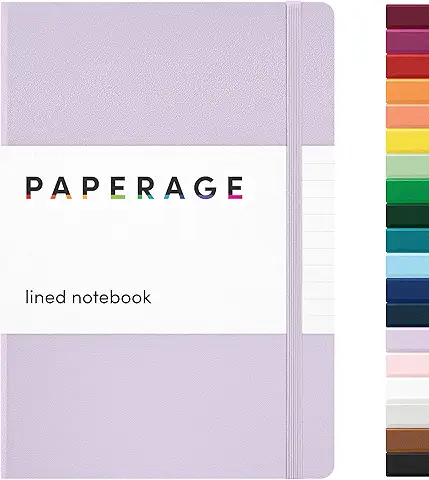
That is where the PAPERAGE Lined Journal Notebook becomes interesting. On the surface, it is a classic hardcover journal. But for the right person, it can function as something more useful: a quiet place where thoughts stop circulating and start settling.
If your mind often feels overstimulated, if you keep collecting ideas without ever really processing them, or if digital note-taking feels too fast and too fragmented, this journal offers a different rhythm. A slower one. A more grounded one. A more human one.
And sometimes, that is exactly what reflective thinking requires.
Why handwriting still feels different from typing
Typing is efficient. That is also its limitation.
When you type, your brain can move quickly from one idea to the next. That speed is useful for communication, but not always for insight. Handwriting is different. It naturally introduces friction. The hand moves slower than the mind, and that small difference changes the quality of attention.
In simple terms, handwriting often encourages the brain to select, slow down, and process rather than simply dump information. For many people, that makes writing by hand feel more reflective, more embodied, and more emotionally honest.
This is why a journal is not just a place to store words.
It is a place to let words arrive at a slower speed.
That slower speed matters for people who live in a high-stimulation environment. Constant input can create the illusion of productivity while actually weakening reflection. A journal interrupts that pattern. It gives the mind a surface. Something physical. Something finite. Something that does not keep asking for notifications.
The PAPERAGE journal understands that kind of use case better than many digital tools do.
What the PAPERAGE journal actually is
The PAPERAGE Lined Journal Notebook is a 5.6″ x 8″ hardcover journal with a vegan leather cover, 160 college-ruled lined pages, an inner expandable pocket, sticker labels, a ribbon bookmark, and an elastic closure band.
That sounds straightforward, but the value is in how these details shape behavior.
A good reflective tool should not demand too much from the user. It should quietly support the act of returning to oneself. PAPERAGE does this by being structured enough to feel intentional, but simple enough not to overwhelm.
There is no complicated system to learn. No prompts forced on the page. No over-designed self-help aesthetic trying too hard to look transformative.
It is just a well-made journal with enough friction-reducing design choices to make actually using it feel natural.
That matters more than people think.
Because the best tools for reflection are often the ones that disappear while you use them.
The cover: durable, water-resistant, and psychologically grounding
The vegan leather hardcover is not merely about looks, although it does give the journal a polished and premium feel. More importantly, it adds a sense of durability.
A journal that feels flimsy can subtly communicate impermanence. A journal with a firm cover feels more like an object worth returning to. It invites a kind of ritual. You open it with intention. You close it knowing what you wrote is being held securely.
That may sound minor, but ritual matters in reflective work.
People do not always need more discipline. Sometimes they need better cues. A well-built notebook can become one of those cues. The physical feel of the cover signals: this is not random scrolling, this is not disposable thought, this is a place for something worth keeping.
The water-resistant quality is practical, but the emotional effect is also real: it makes the journal feel dependable.
And dependable objects tend to get used.
The paper quality: where the real experience begins
One of the strongest features of this journal is the 100 gsm acid-free paper. In journaling, paper quality is not just a technical detail. It changes the experience.
Thicker paper tends to reduce ghosting and bleed-through, which means your writing space feels cleaner and less compromised. That clean page can matter more than expected, especially for people who use a journal to think, not just to archive notes.
There is a subtle psychological effect here.
When the page feels solid, the mind often feels less hesitant.
When ink does not bleed through, the page feels less fragile.
When the writing surface feels smooth and trustworthy, people tend to write more freely.
This is one of the reasons PAPERAGE stands out as a reflective tool rather than just a cheap notebook. It respects the act of writing. It allows most pens, pencils, and markers to feel usable without making the page feel crowded or messy.
For journaling, that matters.
Because reflection becomes easier when the medium itself is not fighting back.
The lay-flat design: small feature, big behavioral impact
The thread-bound lay-flat design is one of those features people underestimate until they actually use it.
A notebook that closes itself while you are writing creates micro-friction. It interrupts thought. It pulls attention back to the physical object instead of the content. A notebook that lays flat removes that interruption.
That makes writing feel more fluid, especially during longer reflective sessions.
If you are right-handed or left-handed, if you are taking notes in a meeting, planning your week, or writing out a thought you are not ready to share with anyone else, a lay-flat journal quietly supports continuity. There is less need to wrestle with the page. Less need to press it open. Less wasted attention.
In behavioral terms, reducing friction increases follow-through.
In emotional terms, it helps the mind stay in the room.
That is why design details like this often matter more than flashy features. The best journaling tools do not announce themselves loudly. They make the act of returning to the page easier.
The inner pocket and sticker labels: structure without pressure
The expandable inner pocket is a practical detail, but it also supports a larger idea: not every thought belongs in one category.
Receipts, appointment cards, loose notes, reminders, small fragments of information, bits of paper from a day that felt too full to organize properly — these are the kinds of things that often end up scattered across a desk or buried in a bag.
The inner pocket gives those fragments a home.
That may sound ordinary, but psychologically it is useful. People often feel mentally cluttered because their environment mirrors their internal disorganization. A pocket inside the journal offers a small form of containment. A place for the unfinished, the temporary, and the in-between.
The sticker labels are also helpful for people who like to organize by purpose. You can label the journal for work, reflection, planning, or personal use. That kind of personalization strengthens ownership, and ownership increases the chance of consistent use.
A journal becomes more useful when it reflects your life instead of forcing you into someone else’s system.
Who this journal is best for
The PAPERAGE Lined Journal Notebook is especially well-suited for people who want a calm, structured, low-distraction writing experience.
It is a strong fit for:
- overthinkers who need a place to slow down
- professionals who want to process thoughts without opening another app
- students who want a clean notebook for notes and reflection
- writers and creators who need a reliable capture space
- people practicing mindfulness, self-reflection, or emotional clarity
- anyone who wants a journal that feels intentional without feeling overly designed
It is especially valuable for readers who feel mentally busy but emotionally under-processed.
That combination is common.
Many people do not need more stimulation. They need a quieter surface for thought.
Who it may not be for
A trustworthy review should also be honest about fit.
This journal may not be the right choice if you want:
- guided prompts built into every page
- a heavily structured planning system
- dotted or grid pages for bullet journaling
- a flashy aesthetic product with lots of extras
- a very large notebook for long-form archive writing
PAPERAGE is elegant because it is restrained. That restraint is part of the appeal, but it also means it is not trying to do everything.
It is not a planner masquerading as a journal.
It is not a productivity system disguised as self-help.
It is a clean, dependable notebook for people who want a simple reflective tool that works.
How to use this journal for mental clarity
A good journal becomes more useful when it has a purpose.
You do not need to overcomplicate it. In fact, simplicity often works better.
Here are a few ways to use it effectively:
Write a three-minute mental dump at the start or end of the day. This helps move scattered thoughts out of working memory and onto the page, where they become easier to see.
Use one page for emotional processing. Instead of trying to “fix” a feeling, describe what it feels like, what triggered it, and what your mind keeps repeating. This creates distance between you and the emotion.
Capture unfinished thoughts before bed. Many people carry unresolved cognitive residue into the night. Writing it down can reduce the sense that the mind still has something to hold.
Use the notebook for reflection, not performance. The page does not need polished language. It only needs honesty.
Track recurring patterns. What keeps showing up in your thoughts? What topics return again and again? A journal often reveals patterns the mind cannot notice while living inside them.
The notebook does not do the thinking for you. It simply makes thinking more visible.
That is already valuable.
What stands out about PAPERAGE specifically
There are many journals on the market, but PAPERAGE stands out because it strikes a rare balance between function and feeling.
It is practical without being plain.
It is attractive without being distracting.
It is simple without feeling cheap.
It is structured without feeling restrictive.
That combination makes it especially suitable for mindfulness and reflection use.
The durable cover makes it feel like a real object worth keeping.
The paper quality supports a comfortable writing experience.
The lay-flat binding reduces friction.
The pocket and labels add just enough utility without turning the notebook into a system you need to manage.
In other words, it respects the psychology of use.
That is what matters most.
A journal is only useful if you actually return to it. And people tend to return to objects that feel calm, reliable, and easy to use.
A realistic verdict
This is not a miracle product. It will not magically create clarity by itself.
But that is also why it is worth recommending.
The best reflective tools are not dramatic. They are dependable.
The PAPERAGE Lined Journal Notebook is a thoughtful choice for people who want a physical space to process thoughts, organize ideas, and create a little more mental room in a noisy world. It is especially useful if you have grown tired of digital overload and want something slower, quieter, and more tactile.
If your days are filled with information but your thoughts rarely get processed, a journal like this can become more than stationery.
It can become a boundary.
A pause.
A place where reflection begins.
<div class=”fmj-cta-box fmj-cta-pulse”> <h3>Give Your Thoughts a Place to Land</h3> <p> If your mind feels full but unclear, you may not need more input. You may need a quieter place to process what is already there. </p> <a href=”https://amzn.to/4ubjgMb” target=”_blank” rel=”sponsored noopener noreferrer”> Explore the PAPERAGE Journal </a> </div>
Frequently Asked Questions
Is the PAPERAGE journal good for daily journaling?
Yes. Its simple lined layout makes it suitable for daily reflection, planning, gratitude writing, and general journaling.
Does the paper work well with pens and markers?
The 100 gsm paper is thicker than average notebook paper, so it is generally better suited for most pens, pencils, and many markers with less bleed-through.
Is it good for left-handed users?
Yes. The lay-flat binding makes writing easier for both right-handed and left-handed users.
Can I use it for work and study notes too?
Absolutely. It works well for journaling, note-taking, planning, and creative writing.
Is this journal more practical or more aesthetic?
It is both, but its real strength is practical. The design is clean and intentional without becoming overly decorative.
Final reflection
Modern life makes it easy to consume information and surprisingly hard to process experience.
That is why a journal still matters.
Not because paper is old-fashioned.
Not because handwriting is trendy.
But because the mind often needs a slower surface to become clear.
The PAPERAGE Lined Journal Notebook is a simple tool, but simplicity is not a weakness here. It is the point. It gives you a clean page, a durable structure, and enough thoughtful design to support real reflective use without turning the experience into another productivity performance.
For the person who is tired of feeling mentally full but internally unprocessed, that may be exactly enough.
Sometimes clarity does not begin with more information.
Sometimes it begins when thoughts finally have somewhere to go.
The PAPERAGE Lined Journal Notebook