
In a world that constantly demands mental output, sometimes the nervous system is not asking for motivation, productivity, or optimization. Sometimes it is simply asking for resonance.

The Strange Exhaustion Most People Can’t Explain
Many people today are not physically tired.
They are neurologically saturated.
The exhaustion feels different.
You sleep, but your mind keeps running background processes.
You finish work, but your attention never fully returns to yourself.
You rest, but internally there is still movement — unfinished thoughts, emotional residue, fragmented focus, low-grade nervous system vigilance.
Modern stress rarely arrives as dramatic breakdown anymore.
It arrives as subtle overstimulation.
A mind that cannot fully land.
And what makes this especially difficult is that most people cannot clearly explain what they are feeling. They simply describe it as:
- “I can’t switch off.”
- “My brain feels noisy.”
- “I’m always mentally somewhere else.”
- “Even silence feels mentally crowded.”
From a neuroscience perspective, this makes sense.
The human brain was never designed for continuous cognitive engagement without rhythmic recovery.
Yet modern life trains the nervous system into exactly that pattern:
- constant notifications
- fragmented attention
- dopamine-driven scrolling
- emotional multitasking
- predictive stress loops
- information saturation
Over time, the brain begins treating stimulation as the default state.
Stillness starts feeling unfamiliar.
Sometimes even uncomfortable.
And this is where many conventional wellness solutions quietly fail.
Why Most “Relaxation” Advice Doesn’t Actually Work
A surprising amount of modern self-care still approaches stress as if it were purely motivational.
People are told to:
- meditate longer
- wake up earlier
- optimize routines
- control thoughts
- increase discipline
- “just be mindful”
But cognitive fatigue does not always respond to force.
In fact, when the nervous system is already overloaded, excessive self-optimization can become another source of internal pressure.
This creates a behavioral paradox.
The more intensely someone tries to “fix” their mental state, the more self-monitoring they create.
The more self-monitoring they create, the less relaxed the nervous system becomes.
This is partly because the brain’s Default Mode Network (DMN) — associated with self-referential thinking and mental wandering — often remains hyperactive in chronically stressed individuals.
The result?
Even relaxation becomes performative.
You sit down to meditate…
…and end up evaluating whether you are meditating correctly.
That subtle performance pressure matters psychologically.
Because true regulation rarely begins with control.
It begins with safety.
And sometimes the nervous system responds more effectively to sensory experiences than cognitive instructions.
Sound is one of those experiences.
Not because it is mystical.
But because rhythm, vibration, repetition, and auditory resonance can influence attention, breathing patterns, emotional pacing, and physiological arousal states in surprisingly powerful ways.
Why Certain Sounds Feel Emotionally Different
There is a reason certain sounds immediately change the emotional atmosphere of a room.
Rain.
Wind.
Temple bells.
Ocean waves.
Low resonant tones.
These sounds often share qualities that the nervous system interprets as rhythmic, non-threatening, and predictable.
Predictability matters.
The brain is fundamentally a predictive organ. It constantly scans the environment asking:
“Am I safe?”
“Do I need to stay alert?”
“Should attention remain externally vigilant?”
Soft repetitive sound patterns can gradually reduce that vigilance load.
Not instantly.
Not magically.
But subtly.
And subtle nervous system shifts are often the most sustainable ones.
This is where tools like a Tibetan Singing Bowl become psychologically interesting.
Not as a productivity hack.
Not as a spiritual performance accessory.
But as an environmental cue that gently interrupts cognitive momentum.
The Tibetan Singing Bowl Set: A Tool for Nervous System Deceleration
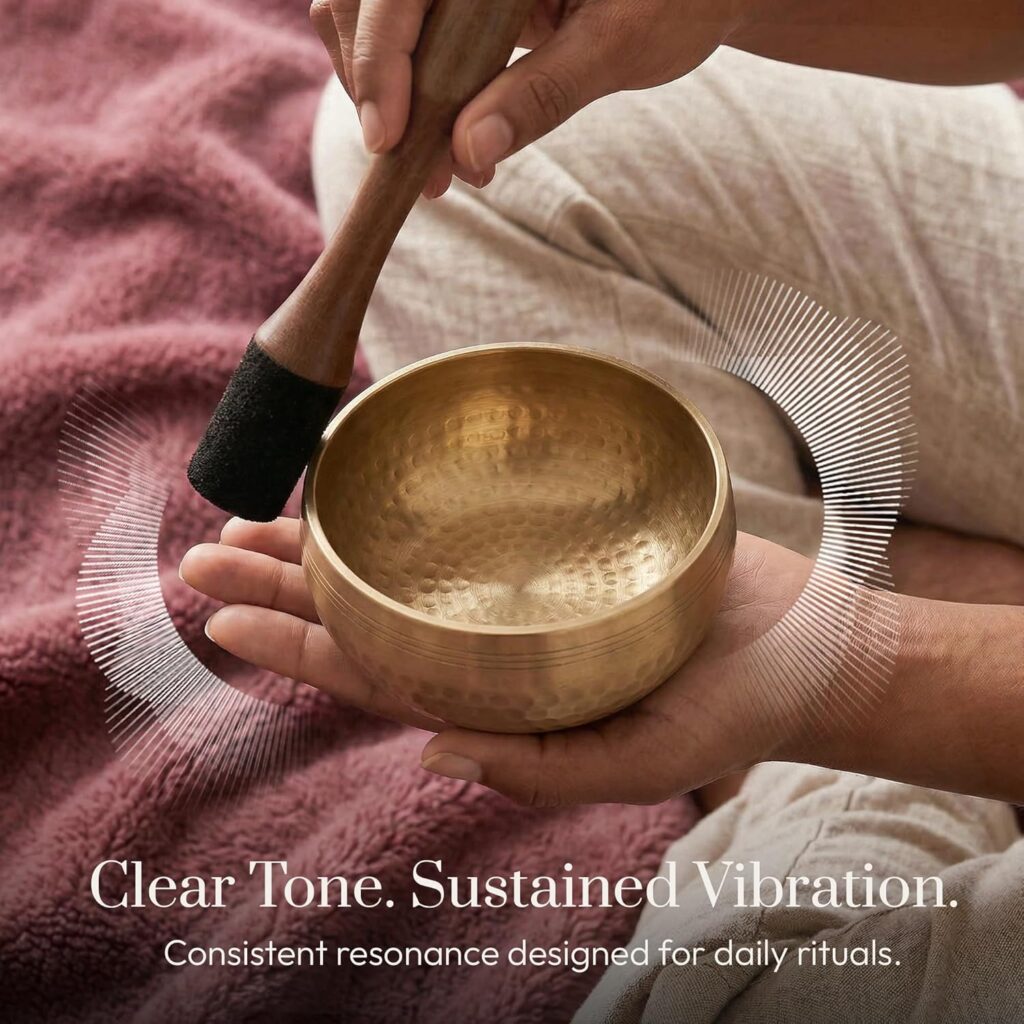
The Tibetan Singing Bowl Set is, on the surface, very simple.
A bowl.
A cushion.
A striker.
But psychologically, its usefulness comes from something deeper:
It reduces friction between intention and calming action.
That matters more than most people realize.
Many wellness practices fail not because they are ineffective…
…but because they require too much activation energy.
Complicated meditation systems.
Rigid routines.
Overwhelming wellness instructions.
An exhausted mind rarely wants another system to manage.
This singing bowl set works differently.
It creates a low-resistance entry point into stillness.
The moment you strike the bowl or move the striker along the rim, the sound immediately changes the emotional texture of the environment.
Not dramatically.
But noticeably.
And that subtle environmental shift can help the brain transition out of continuous cognitive engagement.
Especially for people who:
- struggle with racing thoughts
- feel emotionally overstimulated
- experience attentional fragmentation
- want a softer entry into meditation
- dislike rigid mindfulness structures
- need sensory grounding rather than mental instruction
What Makes This Bowl Particularly Beginner-Friendly
One of the most psychologically important aspects of this set is something many reviews overlook:
It is easy to use.
That sounds minor.
It is not.
Behavioral science repeatedly shows that people sustain habits when early experiences feel achievable rather than frustrating.
Many first-time meditation tools accidentally create performance anxiety:
- “Am I doing this correctly?”
- “Why can’t I focus?”
- “Why does this feel awkward?”
But this bowl is designed in a way that allows even beginners to produce a resonant tone relatively quickly.
That immediate feedback matters neurologically.
The brain rewards small successful interactions.
Success reduces resistance.
Reduced resistance increases repetition.
And repetition is how calming rituals become psychologically anchored habits.
The bowl does not demand expertise before providing emotional value.
That creates emotional accessibility.
The Sound Experience Feels Different Than Digital Relaxation
One of the most overlooked aspects of physical mindfulness tools is sensory realism.
Apps can absolutely help.
Guided meditations can help.
But digital wellness still occurs through the same device ecosystem often associated with stress, work, notifications, comparison, and overstimulation.
A physical singing bowl changes the modality entirely.
You are not consuming calm.
You are generating it.
That distinction matters psychologically.
The act of physically creating sound:
- increases sensory involvement
- anchors attention into the body
- interrupts compulsive screen behavior
- creates intentional pacing
- slows cognitive velocity
The vibrations themselves also create an interesting attentional effect.
Instead of forcing concentration, the sound gently occupies mental bandwidth.
This reduces the “empty silence panic” many beginners experience during meditation.
Your attention has something soft to rest against.
And for many overstimulated minds, that makes mindfulness feel emotionally safer.
The Emotional Atmosphere It Creates
There is also an environmental psychology layer here that deserves attention.
Objects influence behavior.
Not aggressively.
But continuously.
A singing bowl placed visibly in a room subtly communicates something to the nervous system:
pause exists here.
That environmental cue can matter more than motivation.
Human behavior is highly context-dependent.
We become shaped by repeated micro-signals in our environment.
A calm object in a chaotic space acts almost like a behavioral anchor.
Over time, the brain begins associating the bowl’s sound with:
- slower breathing
- emotional decompression
- quieter mental pacing
- intentional stillness
This is how rituals form.
Not through discipline alone.
But through repeated emotional association.
My Personal Observation After Repeated Listening
Something interesting happens after listening repeatedly.
At first, the sound feels external.
You hear it.
But after some repetition, the experience becomes more internalized.
The resonance starts feeling less like “audio” and more like atmosphere.
Almost as if mental noise temporarily loses its sharp edges.
You become aware of thoughts without getting pulled by each one.
Not because the bowl removes thinking.
But because it changes your relationship to mental movement.
There is a subtle psychological spaciousness that begins appearing between thoughts.
That space matters.
Because emotional exhaustion is not always caused by having thoughts.
Sometimes it is caused by never getting distance from them.
Bonus Resources: Why Guidance Matters for Habit Formation
This set also includes learning resources:
- an eBook series
- user guidance
- sound bath audio
Psychologically, this is more useful than it initially appears.
Beginners often abandon mindfulness tools because uncertainty creates friction.
Clear guidance reduces ambiguity.
And ambiguity is cognitively expensive.
When people understand:
- how to hold the striker
- how to create resonance
- how to integrate the bowl into routines
…the experience becomes emotionally smoother.
The included sound bath audio is also helpful because it introduces users to immersive listening without requiring advanced meditation experience.
That gradual onboarding process supports behavioral consistency.
And consistency matters more than intensity in emotional regulation practices.
The Neuroscience of Why Sound-Based Rituals Can Feel Grounding
Sound-based mindfulness practices engage multiple regulatory mechanisms simultaneously.
Not in a mystical sense.
In a nervous-system sense.
Repetitive resonant tones may support:
- attentional stabilization
- slower respiratory pacing
- parasympathetic activation
- sensory grounding
- emotional downshifting
There is also evidence that rhythmic auditory stimulation can influence brainwave synchronization and emotional regulation patterns.
More importantly, however, the experience creates predictability.
And predictability lowers cognitive threat monitoring.
This is especially valuable for people experiencing:
- chronic overstimulation
- emotional burnout
- cognitive fatigue
- constant internal urgency
The bowl becomes less about “achieving enlightenment”…
…and more about teaching the nervous system how to stop accelerating for a moment.
That is psychologically meaningful.
Who This Product Is Actually Good For
This Tibetan Singing Bowl Set is especially useful for:
- beginners exploring meditation
- people overwhelmed by digital overstimulation
- emotionally fatigued professionals
- sensitive thinkers with racing minds
- individuals building evening calming rituals
- breathwork practitioners
- yoga or mindfulness beginners
- people who struggle with silent meditation
- individuals seeking tactile grounding tools
It is also surprisingly helpful for people who dislike rigid wellness culture.
Because the experience feels less like “performing mindfulness” and more like creating an emotional atmosphere.
Who Might NOT Benefit Much From It
Balanced expectations matter.
This bowl is probably NOT ideal for:
- people expecting instant transformation
- those seeking highly advanced professional sound-healing equipment
- individuals wanting loud dramatic resonance
- people unwilling to engage consistently with calming rituals
- users expecting the product itself to “fix” anxiety
A singing bowl is not a replacement for therapy, emotional processing, sleep hygiene, or medical support.
It is a supportive environmental tool.
And understanding that distinction increases satisfaction.
What Ownership Actually Feels Like
The real value of this bowl often appears in small moments.
A difficult afternoon.
A mentally noisy evening.
A transition between work and rest.
A few quiet minutes before sleep.
You reach for the striker almost automatically.
Not because someone told you to.
But because your nervous system begins associating the sound with decompression.
That is how emotionally intelligent habits form.
Quietly.
Without force.
And over time, the ritual itself becomes psychologically reassuring.
Not in a dependency-driven way.
But in the same way certain places, songs, or evening routines begin signaling safety to the brain.
Soft Reflection Before Buying
If your mind constantly feels overstimulated…
If silence feels mentally crowded…
If traditional productivity-focused wellness advice leaves you more exhausted instead of calmer…
Then tools that work with human nervous-system reality — rather than against it — can feel surprisingly relieving.
The Tibetan Singing Bowl Set will not “transform your life overnight.”
But it may help create something many modern minds quietly lack:
a repeatable moment of internal deceleration.
And sometimes that is where emotional recovery begins.
Gentle Recommendation
This is not the kind of product people buy because they need another object.
It is usually purchased because some part of the nervous system is asking for a different rhythm.
A slower one.
A softer one.
A more intentional one.
If that feeling sounds familiar, this bowl may become less of a wellness accessory…
…and more of a small daily ritual that helps your mind remember how to settle.
You can explore the Tibetan Singing Bowl Set here:
https://amzn.to/3PsaP0L
FAQ Section
Is a Tibetan singing bowl useful for beginners?
Yes. Especially for people who find traditional meditation difficult or mentally overwhelming. The sound provides an external anchor for attention, which can make mindfulness feel more approachable.
Can a singing bowl reduce stress?
It can support stress reduction indirectly by helping create calming rituals, slowing attentional pacing, and encouraging nervous-system decompression. It is not a medical treatment, but many people find the experience emotionally grounding.
Do you need meditation experience to use it?
No. This set is specifically designed for first-time users and includes guidance materials that help reduce beginner frustration.
Is the sound very loud?
No. Most beginner-friendly singing bowls produce a soft resonant tone intended for calming environments rather than dramatic volume.
How long should you use a singing bowl?
Even a few intentional minutes can help create a mental transition between stress and rest. Consistency generally matters more than duration.
Affiliate Disclosure
Some links in this article may be affiliate links, which means FitMindJournal may earn a small commission if you choose to make a purchase — at no additional cost to you.
We only recommend products that align with our philosophy of emotional well-being, psychological awareness, and sustainable self-care. Our goal is not to push unnecessary consumption, but to thoughtfully explore tools that may genuinely support healthier mental environments and calmer daily rituals.