

You’re Not Seeing the World, You’re Guessing It
Pause for a moment and look around you.
It feels immediate, direct, unquestionable—as if your brain is simply receiving reality through your senses.
But neuroscience suggests something far more unsettling:
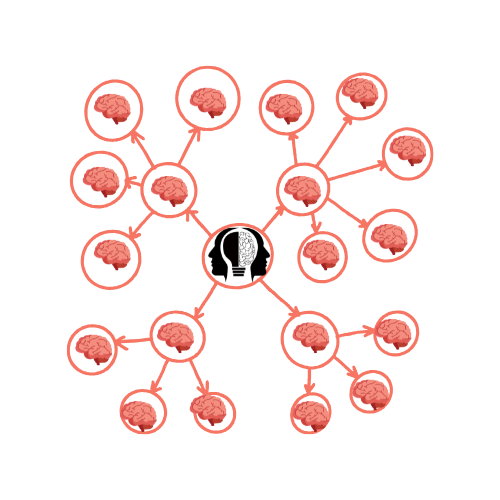
You are not perceiving the world. You are predicting it—and only occasionally correcting yourself.
In fact, what you experience as “reality” is a controlled hallucination—one that is constrained and updated by sensory input.
This isn’t metaphor. It’s one of the most influential frameworks in modern neuroscience.
And it changes everything—from how you understand stress and bias to how you train focus, emotion, and identity.
Conceptual Foundation — The Brain as a Prediction Machine
At the core of predictive processing theory is a simple but radical idea:
The brain does not passively receive information. It actively generates models of the world and tests them against incoming data.
Key Components of the System
1. Top-Down Predictions
Generated by higher brain regions:
- Prefrontal cortex (planning, expectations)
- Default Mode Network (DMN) (self-referential narratives)
These predictions answer:
- What am I seeing?
- What does this mean?
- What will happen next?
2. Bottom-Up Sensory Signals
Incoming data from:
- Visual cortex (sight)
- Auditory cortex (sound)
- Somatosensory cortex (touch)
These signals provide error feedback.
3. Prediction Error
The difference between:
- What the brain expects
- What actually occurs
This “error signal” is critical.
The brain is constantly trying to minimize prediction error.
4. Precision Weighting
Not all signals are treated equally.
The brain assigns confidence (precision) to:
- Predictions (beliefs, expectations)
- Sensory input (current data)
This determines what gets updated—and what gets ignored.
Deep Explanation — How Reality is Constructed
Let’s walk through the mechanism step by step.
Step 1: The Brain Generates a Model
Before sensory input even arrives, your brain is already predicting:
- “This is a face.”
- “This is my colleague.”
- “This situation is stressful.”
These predictions are based on:
- Past experiences
- Learned patterns
- Emotional conditioning
Step 2: Sensory Input Arrives
Your senses send raw, noisy data upward.
But this data is incomplete.
The brain never receives a full picture—only fragments.
Step 3: Comparison and Error Detection
The brain compares:
- Prediction vs input
If they match:
- Perception feels smooth and immediate
If they don’t:
- Prediction error arises
Step 4: Error Minimization
The brain has two options:
- Update the model
- “I was wrong—adjust the prediction”
- Ignore or reinterpret the input
- “The input is unreliable—stick to the belief”
This is where things get interesting.Step 5: Reality Stabilizes
What you ultimately “see” or “feel” is:
The brain’s best guess after minimizing prediction error.
Not raw reality—a constructed interpretation.
Research Integration — The Scientific Backbone
Predictive processing is not speculative philosophy—it is grounded in multiple research domains.
1. The Free Energy Principle (Karl Friston)
Friston’s framework suggests:
The brain minimizes “free energy” (uncertainty) by continuously updating its internal models.
This connects prediction error to survival:
- Less error = more stability
- More error = more uncertainty
2. Visual Perception Studies
Experiments show that:
- The brain fills in blind spots
- Context shapes perception (e.g., optical illusions)
This demonstrates:
Perception is inference, not direct observation.
3. Placebo and Expectation Effects
Clinical research reveals:
- Belief alone can reduce pain
- Expectations can alter physiological responses
This is predictive processing in action:
The brain’s model influences bodily experience.
4. Anxiety and Depression Models
In psychopathology:
- Anxiety = overprediction of threat
- Depression = rigid negative priors
These are not just “emotional states”—they are maladaptive predictive models.
Real-World Translation — How This Shapes Your Life
This framework is not abstract—it explains everyday experience with precision.
1. Why You Overreact
You don’t react to events—you react to predictions.
If your brain predicts:
- “This is dangerous”
- “I will be judged”
Your body responds before reality confirms it.
2. Why Habits Feel Automatic
Your brain prefers efficient predictions.
Repeated behaviors become:
- Low-error
- High-confidence models
This is why habits feel effortless—and hard to break.
3. Why Focus is Difficult
Distraction is not random.
It’s driven by competing predictions:
- “Check your phone”
- “This task is boring”
The brain selects the prediction with higher perceived value or urgency.
4. Why Change Feels Uncomfortable
New behavior = high prediction error.
Your brain interprets this as:
- Uncertainty
- Potential risk
So it resists—not because change is bad, but because it is unfamiliar.
Cognitive Reframe — Reality is Negotiated, Not Given
The common belief:
“I see the world as it is.”
Predictive processing suggests:
You see the world as your brain expects it to be.
This leads to a powerful mental shift:
- Perception is interpretation
- Emotion is prediction
- Identity is a model
You are not just experiencing reality—you are co-creating it.
Practical Protocols — Updating Your Predictive Brain
If your brain constructs reality, then the goal is not control—it is calibration.
Protocol 1: Prediction Awareness
Step-by-step:
- Notice your immediate reaction
- Ask: “What did I expect just now?”
- Identify the prediction
Effect:
- Brings unconscious models into awareness
- Weakens automatic responses
Protocol 2: Error Tolerance Training
- Intentionally do something slightly uncomfortable
- Stay present with the discomfort
- Avoid immediate escape
Why it works:
- Teaches the brain that prediction error is safe
- Expands behavioral flexibility
Protocol 3: Sensory Grounding
- Focus on raw sensory input:
- What do I actually see, hear, feel?
- Avoid interpretation
Mechanism:
- Reduces top-down dominance
- Strengthens bottom-up processing
Protocol 4: Belief Testing
- Identify a recurring thought:
- “I’m not good enough”
- Test it with real-world action
- Compare outcome vs prediction
Effect:
- Updates faulty priors
- Builds adaptive models
Psychological Insight Layer — The Architecture of Identity
Your identity is not fixed—it is a predictive construct.
The Self as a Model
The brain maintains a model of:
- Who you are
- What you can do
- How others see you
This model:
- Filters perception
- Guides behavior
- Reinforces itself
The Loop of Confirmation
Predictions drive behavior → behavior confirms predictions.
Example:
- “I’m not confident”
- Avoid challenges
- No success experiences
- Belief reinforced
Breaking the Loop
Change requires:
- Introducing prediction error
- Updating the model
Not through thinking alone—but through experience.
Meta-Awareness as Override
When you become aware of your predictions:
- You are no longer fully controlled by them
- You gain the ability to intervene
This is the beginning of cognitive freedom.
Closing Insight — The Reality You Practice
Your brain is always learning.
Not from what you intend—but from what you repeatedly experience and predict.
So the real question is not:
“Is this thought true?”
But:
“Is this the kind of model I want my brain to strengthen?”
Because over time, your predictions become your perceptions.
Your perceptions become your reality.
And your reality becomes your life.
Final Reflection:
If reality is something your brain constructs…
then the most powerful change you can make is not in the world outside—
but in the predictions you allow your mind to practice every day.